
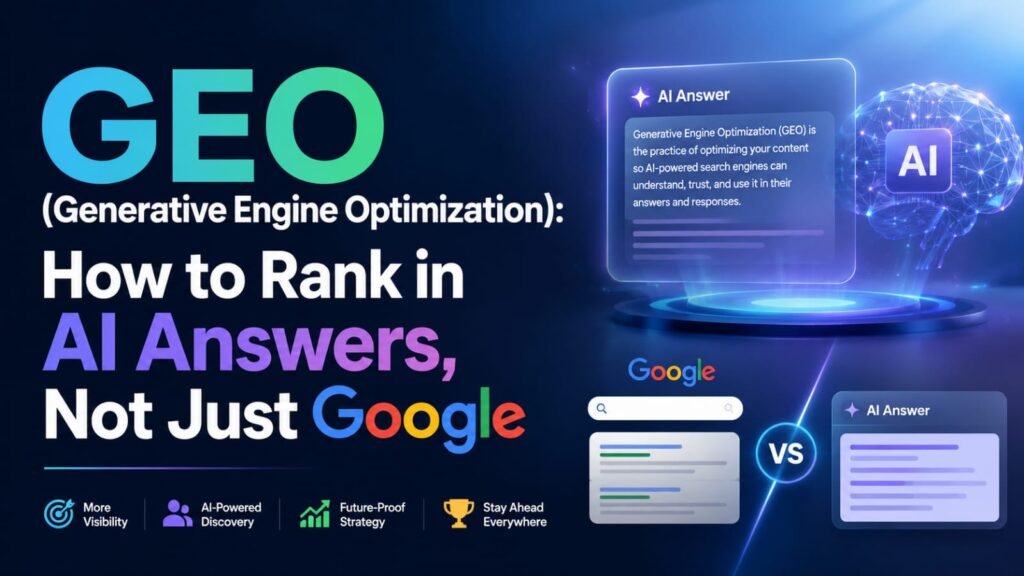
GEO (Generative Engine Optimization): How to Rank in AI Answers, Not Just Google
You’ve probably felt it already. You ask ChatGPT a question, or Google throws an AI Overview at the top of your search, and you get your answer without clicking a single link. No scrolling. No comparing ten blue links. Just… an answer.
Great for you as a searcher. Terrifying for you as a marketer.
Because if AI is answering the question before someone even reaches your website, then ranking #1 on Google doesn’t mean what it used to. This is exactly why a new discipline has exploded in the last couple of years: **GEO, or Generative Engine Optimization**.
Let’s break down what Generative Engine Optimization actually is, why it matters right now, and how to implement it effectively—without the jargon that most guides overwhelm you with. As a Digital Marketing Expert, I believe that understanding Generative Engine Optimization and these evolving strategies is essential for improving online visibility, staying ahead of the competition, and achieving long-term digital marketing success. Whether you’re a business owner, marketer, or entrepreneur, mastering Generative Engine Optimization can help you increase your brand’s visibility in AI-powered search experiences and future-proof your digital marketing strategy.
What Is GEO, Really?
In plain English: GEO is the practice of getting your content quoted, cited, or referenced inside the answers that AI tools generate — instead of just trying to rank in a list of search results.
Think ChatGPT, Perplexity, Google’s AI Overviews, Gemini, and Claude. When someone asks one of these tools a question, the AI doesn’t just hand back ten links. It reads across multiple sources, digests them, and writes a synthesized answer. GEO is about making sure your brand’s information is one of the ingredients that goes into that answer.
Traditional SEO asks: *”How do I get my page to rank on page one?”*
GEO asks: *”How do I get my content picked as a source when the AI writes its answer?”*
Same neighborhood, different house.
Why This Isn't Just Hype
A few numbers explain why marketers are suddenly obsessed with this:
– ChatGPT has grown to hundreds of millions of weekly active users, and a lot of buying research now happens entirely inside a chat window — no search results page involved at all.
– Zero-click searches — where someone gets their answer without clicking through to any website — have climbed sharply since AI Overviews rolled out widely.
– Research from GEO analytics firms has found that the overlap between what ranks on page one of Google and what actually gets cited by AI tools has dropped dramatically — meaning ranking well on Google is no longer a reliable predictor of showing up in an AI answer.
Translate that into plain terms: **you can be sitting comfortably at the top of Google and still be completely invisible inside ChatGPT or an AI Overview.** That gap is only growing.
GEO vs. SEO vs. AEO — What's the Actual Difference?
A few numbers explain why marketers are suddenly obsessed with this:
– ChatGPT has grown to hundreds of millions of weekly active users, and a lot of buying research now happens entirely inside a chat window — no search results page involved at all.
– Zero-click searches — where someone gets their answer without clicking through to any website — have climbed sharply since AI Overviews rolled out widely.
– Research from GEO analytics firms has found that the overlap between what ranks on page one of Google and what actually gets cited by AI tools has dropped dramatically — meaning ranking well on Google is no longer a reliable predictor of showing up in an AI answer.
Translate that into plain terms: **you can be sitting comfortably at the top of Google and still be completely invisible inside ChatGPT or an AI Overview.** That gap is only growing.
You’ll see three acronyms floating around, and honestly, most people use them interchangeably at this point. Here’s the cleanest way to think about it:
– **SEO** chases a ranking position on a results page.
– **AEO** (Answer Engine Optimization) chases the featured-snippet or “position zero” answer box.
– **GEO** chases the citation *inside* an AI-generated response, blended together with other sources.
They overlap heavily, and none of them replace each other. A strong SEO foundation—technical health, high-quality content, and real authority—remains the base on which all three are built. Generative Engine Optimization (GEO) doesn’t replace SEO; it adds a new layer on top of it by optimizing content for AI-powered search experiences and generative engines. As a Digital Marketing Expert, I believe that combining SEO, Generative Engine Optimization, and AI optimization strategies is the key to improving online visibility, increasing brand authority, earning more visibility in AI-generated answers, and achieving long-term digital marketing success.
How AI Engines Actually Decide What to Cite
You can’t optimize for a system you don’t understand, so here’s roughly what happens behind the scenes when someone asks an AI a question:
**1. The question gets broken apart.** Most AI tools don’t just search your exact question. They break it into smaller sub-questions and search each one separately. Ask “best budget laptop for college students in 2026” and the AI might quietly search “best budget laptops 2026,” “laptops for college students,” and “affordable laptop reviews” as three separate queries.
**2. It retrieves content from the web.** Most generative engines use a method called retrieval-augmented generation (RAG) — they pull live pages, read them, and pass the useful bits to the language model.
**3. It synthesizes an answer.** The model blends information from multiple sources into one clean response, deciding which facts and phrases are worth including — and which source gets the credit.
That third step is where GEO lives. Your job is to make your content so clearly structured and clearly *citable* that it’s the easy pick when the AI is assembling its answer.
## Practical Ways to Actually Do GEO
Here’s where most guides get vague. Let’s not do that.
**Answer the question immediately, not eventually.**
AI tools evaluate a page’s relevance largely based on how it opens. If your blog post spends 400 words on a cute intro before answering the actual question, you’re making the AI work to find the point — and it usually won’t bother. Answer the core question in the first couple of sentences, then go deeper below.
**Make sure AI crawlers can even reach your site.**
This sounds too basic to matter, but it’s one of the most common issues out there. Check your robots.txt file. Some hosting platforms and CDNs have started blocking AI bots by default, which means your beautifully optimized content might be invisible to these systems for a reason that has nothing to do with quality.
**Structure content for extraction, not just readability.**
Clear headers, FAQ sections, bullet points, and defined terms make it easy for an AI to lift a clean, self-contained answer from your page. Walls of unbroken text are hard to extract from — even if the information inside is great.
**Back up claims with real data and specifics.**
Statistics, original research, expert quotes, and named sources make your content more “synthesis-worthy.” Vague claims get skipped over; specific, attributable ones get quoted.
**Build brand mentions everywhere, not just backlinks.**
AI models weigh brand authority differently than traditional search engines do. They pay attention to how often your brand shows up across credible publications, forums, review sites, and other trusted corners of the web — not just how many sites link to you. A lot of AI citations trace back to earned media coverage rather than a company’s own website.
**Keep your core SEO fundamentals strong.**
Technical site health, genuine expertise, solid structured data, and real topical authority still matter enormously. GEO builds on top of good SEO — it doesn’t replace it.
How Do You Even Measure This?
Traditional rank tracking doesn’t really apply here, since there’s no “position 4” inside a ChatGPT answer. Instead, marketers are starting to track a newer metric often called Share of Model (or Share of Voice in AI)—essentially, how often your brand gets mentioned in AI-generated answers compared to your competitors across a set of relevant queries. As a Digital Marketing Expert, understanding and optimizing for AI visibility is becoming an essential part of modern digital marketing strategies. Several newer tools now exist specifically to monitor this emerging and rapidly evolving area of analytics, helping businesses strengthen their online presence and stay ahead of the competition.
The Bottom Line
Ranking on Google used to be the finish line. Now it’s just one leg of the race. The businesses that will win visibility over the next few years are the ones embracing Generative Engine Optimization (GEO) and treating AI-generated answers as their own separate channel—one with its own rules, content structure, and way of measuring success. Generative Engine Optimization helps businesses optimize their content for AI-powered platforms like ChatGPT, Google AI Overviews, and Gemini, increasing the chances of being referenced in AI-generated responses. As a Digital Marketing Expert, I help businesses implement Generative Engine Optimization alongside modern SEO strategies, AI-ready content, and data-driven digital marketing solutions to improve online visibility, earn AI citations, and achieve long-term business growth.